Green home builders Baltimore County, MD homeowners hire in 2026 do more than install solar panels and call a project sustainable. The real difference shows up in sealed building envelopes, tested HVAC loads, and certifications backed by an independent verifier's signature, not just a logo on a brochure. Here's how to tell a genuinely green build from a marketing claim, and what Maryland's current energy code actually requires before you sign a contract.
Visit LP Homes Inc to see our services and request a free estimate.
How to Vet a Green Home Builder in Baltimore County
Anyone can say "eco-friendly" on a website. A few questions separate builders who document their performance from builders who just talk about it.
- Confirm an active Maryland Home Improvement Commission license and current insurance before discussing design.
- Ask which certification program the builder actually builds to, NGBS, ENERGY STAR, or DOE Zero Energy Ready Home, and request a sample verification report rather than a logo.
- Request blower-door and duct-leakage test numbers from a recent local project, since a generic national average doesn't tell you how the house performs in Baltimore County's humidity.
- Walk through a completed project in person. Moisture problems from rushed air-sealing tend to surface within a few years in this climate, not immediately at closing.
- Confirm who performs third-party verification.
To earn the ENERGY STAR, a new home or apartment must undergo a rigorous process of third-party inspections and testing, performed by an independent home energy rating company rather than the builder grading its own work.
On our own Baltimore County projects, we've found that a builder willing to show you an actual HERS or ERI printout from a prior job, not just a certificate, is usually the one worth hiring.
Explore our custom home construction services to see how these standards apply to a real build.
What Counts as a Green Home Build
A green home is designed and built to use less energy, conserve water, and rely on nontoxic, resource-efficient materials from foundation to finish. Baltimore County's housing stock skews older, and many homes predate modern insulation and air-sealing standards. Pairing eco-friendly construction with the region's humid summers and damp winters helps a new build perform better, and age slower, than one built to decades-old code.
Green Building Strategies That Improve Everyday Performance
Solar & Passive Design
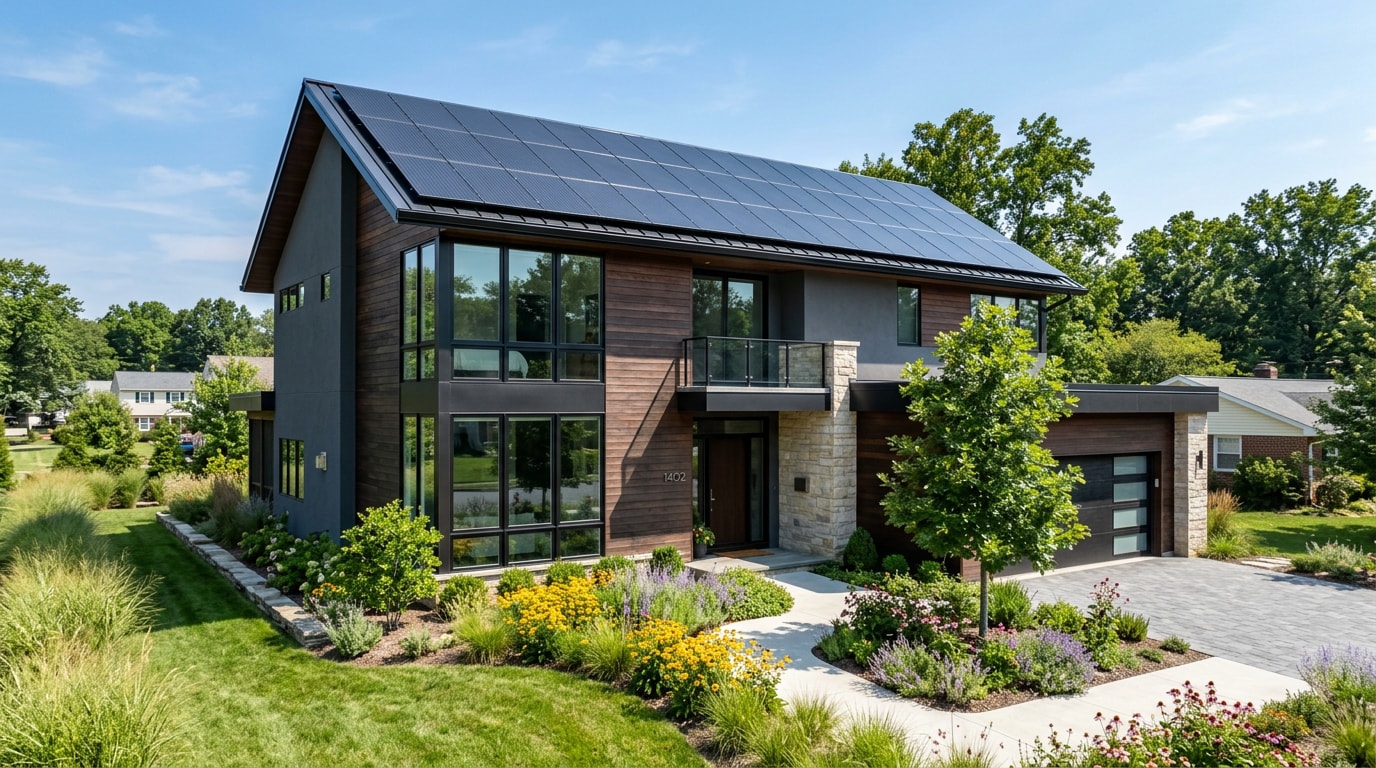
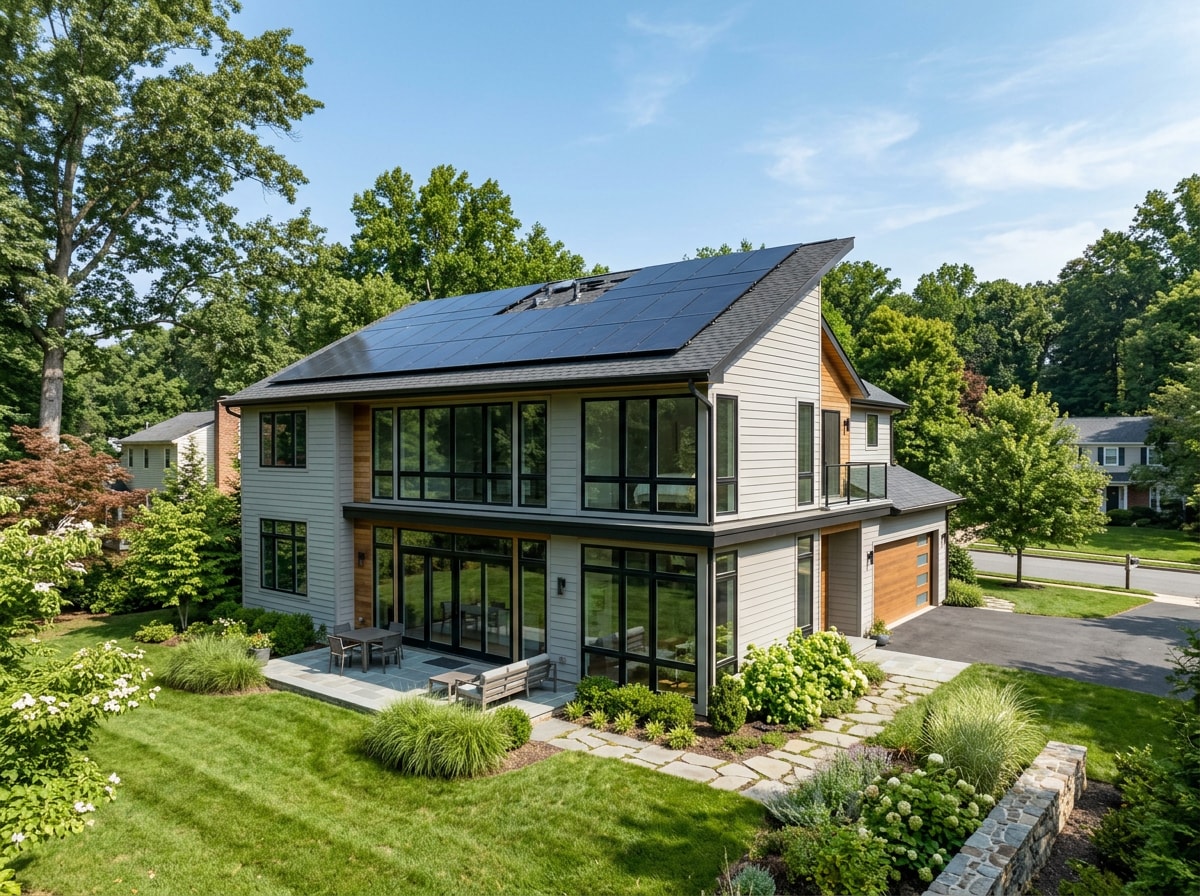
Passive solar design starts with orientation, not equipment. Maryland's sun path favors homes with south-facing windows that capture low-angle winter sun for free heat, while roof overhangs block the higher summer sun and ease cooling loads before a single panel goes on the roof.
A floor plan rotated to align the main living space southward, then fitted with a correctly sized photovoltaic array, can shift a home from net energy consumer toward near net-zero without enlarging the system. Pairing good orientation with renewable equipment generally outperforms bolting panels onto a poorly oriented house.
Sustainable & Salvaged Materials
Material choices matter almost as much as mechanical systems. Sustainable materials include responsibly harvested wood, recycled-content countertops, and low-emission paints and finishes that keep indoor air cleaner. Many projects also incorporate salvaged materials, reclaimed flooring, vintage doors, repurposed cabinetry, for homes where character and resource savings matter as much as brand-new everything.
Blending new sustainable materials with a few salvaged pieces often costs less than an all-new, high-end package while giving a home more personality.
Energy-Efficient Layout, Systems & Native Landscaping
Compact Layout & Right-Sized Systems
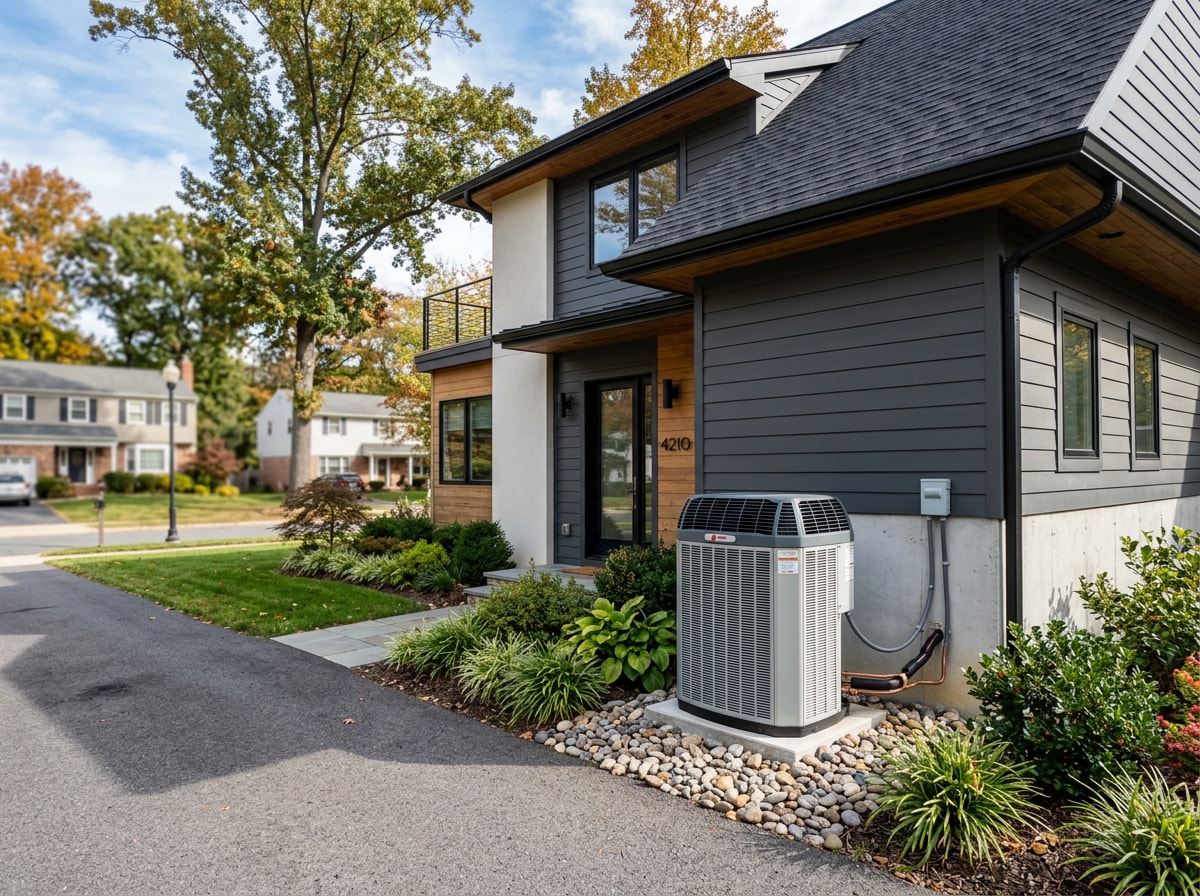
A compact, two-story layout holds heated or cooled air more efficiently than a sprawling single-story footprint of the same square footage, simply because less roof and exterior wall meet outside temperatures. That efficiency compounds when paired with ENERGY STAR appliances, a right-sized water heater, and HVAC equipment matched to actual heating and cooling loads instead of oversized out of habit.
Geothermal heat pump systems take this further, using stable underground temperatures instead of outdoor air, trading a higher upfront cost for lower monthly utility bills over the system's life.
Native Plant Landscaping
Plants adapted to Maryland's climate need less supplemental watering once established, and drought-tolerant species hold up through dry summer stretches without constant irrigation. Native landscaping also supports local pollinators and cuts down on the mowing and chemical treatments a traditional lawn demands.
Maryland's 2026 Energy Code: What Baltimore County Builders Must Meet
Maryland adopted the 2021 editions of the IECC and IRC for residential construction, making them operative for permitted work initiated after their effective adoption date.
Maryland falls entirely within IECC Climate Zone 4A (Mixed-Humid) , which covers Baltimore County and sets the minimums for wall and attic insulation, window performance, and air sealing.
One detail most builder websites skip: Maryland didn't adopt the 2021 IECC's insulation tables as written. 2021 IECC wall and ceiling insulation levels were amended and reverted back to 2018 IECC levels by adding a Maryland Alternative R-value table. That means a builder quoting straight 2021 IECC national R-values, rather than Maryland's amended figures, is working from the wrong reference sheet.
For homes using the performance compliance path, Maryland's code sets a maximum Energy Rating Index of 54 for Climate Zone 4 , meaning a lower score always indicates a more efficient home. Builders verify envelope sealing with a blower-door test, which measures how much conditioned air escapes a finished house.
Meeting code is the floor, not the ceiling. Many builders design toward ENERGY STAR or the Department of Energy's Zero Energy Ready Home program, both requiring stricter insulation, better equipment, and verified testing beyond the baseline. Full climate zone 4 specifics are published in the Department of Energy's Maryland residential energy code cost-effectiveness analysis.
Green Certifications & Incentives Worth Asking About
Beyond code compliance, a handful of third-party programs let you verify, on paper, how green a finished home really is.
| Program | Who Administers It | What It Covers | Typical Incentive |
|---|---|---|---|
| NGBS (National Green Building Standard) | Home Innovation Research Labs | Lot design, resource and water efficiency, energy efficiency, indoor air quality, operations | Bronze, Silver, Gold, Emerald tiers |
| ENERGY STAR Certified Homes | U.S. EPA | Whole-home energy performance verified by a third-party rater | Federal tax credit up to $2,500 per home |
| DOE Zero Energy Ready Home | U.S. Department of Energy | Energy performance plus indoor air quality and durability, built on ENERGY STAR | Federal 45L tax credit up to $5,000 per home |
The NGBS includes high-performance building practices in six areas: Lot Design and Development, Resource Efficiency, Water Efficiency, Energy Efficiency, Indoor Environmental Quality, and Building Operation & Maintenance, with certification levels of Certified, Bronze, Silver, Gold and Emerald.
Home Innovation Research Labs has certified the compliance of over 750,000 dwelling units under the standard, making it one of the most widely used residential green rating systems in the country. Full tier definitions are published by Home Innovation Research Labs.
A DOE Zero Energy Ready Home is a high-performance home that is so energy efficient that a renewable energy system could offset most or all the home's annual energy use.
Certified homes are eligible to receive the federal 45L tax credit, up to $5,000 per home, through 2032. See the DOE Zero Energy Ready Home Program for current eligibility.
ENERGY STAR carries its own financial case. High-performance homes sell for significant price premiums compared to typical homes, and ENERGY STAR certified and similarly efficient homes enjoy sales price premiums of up to 6%. Builders can also earn tax credits of up to $2,500 for building ENERGY STAR certified homes and apartments acquired before July 1, 2026. Review the ENERGY STAR new homes program for full requirements.
Ready to compare a certified energy model against a standard build before you finalize blueprints? Get a Free Estimate and bring your lot details to the conversation.
For a deeper look at how these standards apply to new construction specifically, see our custom home construction guide for Baltimore County. You can also check our Baltimore County service area page to confirm coverage near you, and visit the {{SITE_URL}}/ homepage for our full range of general contracting services.
FAQ
What qualifies a home as a "green" build in Baltimore County?
A green build combines energy-efficient design (orientation, insulation, right-sized HVAC), low-impact materials, and water-conscious landscaping, usually verified through a third-party program like NGBS, ENERGY STAR, or DOE Zero Energy Ready Home rather than self-reported claims.
Do green homes cost more to build than standard homes?
Upfront costs can run higher for certified homes due to testing, verification fees, and higher-spec materials. Much of that gap is offset over time: ENERGY STAR and similarly efficient homes can command sales price premiums of up to 6%, and federal tax credits of up to $5,000 are available for DOE Zero Energy Ready Home certification.
What's the difference between NGBS, ENERGY STAR, and DOE Zero Energy Ready Home certification?
ENERGY STAR focuses narrowly on energy performance. DOE Zero Energy Ready Home builds on ENERGY STAR requirements and adds indoor air quality and durability criteria. NGBS is broader still, scoring lot design, water efficiency, resource efficiency, energy efficiency, and indoor environmental quality within one residential framework, with Bronze through Emerald tiers.
What tax credits are available for green home construction in Maryland?
Builders can receive a federal tax credit of up to $2,500 per ENERGY STAR certified home acquired before July 1, 2026, and up to $5,000 per home certified through the DOE Zero Energy Ready Home program through 2032. Check current program pages before relying on either figure for a specific project.
How do I vet a green home builder before signing a contract?
Confirm an active MHIC license and insurance, ask which certification program they build to and request a sample verification report, and ask for blower-door or duct-leakage test results from a recent local project rather than a national average.
What does Maryland's energy code require for new construction in Baltimore County?
Maryland has adopted the 2021 IECC with state-specific amendments, including insulation tables that revert to 2018 IECC levels rather than the stricter national 2021 defaults. Climate Zone 4A governs Baltimore County, and the performance path caps the Energy Rating Index at 54.
What is a HERS or ERI score, and what should a new home in Baltimore County aim for?
Both scores measure energy performance on a scale where a lower number means better efficiency; 100 represents a standard reference home. Maryland's performance path requires an Energy Rating Index of 54 or lower in Climate Zone 4, and homes pursuing ENERGY STAR or Zero Energy Ready certification are built to score well below that baseline.
About This Guide
This guide was prepared by the team at LP Homes Inc, a licensed general contractor building and remodeling homes across Baltimore County, Harford County, Baltimore City, and Southern Cecil County, MD. Questions about a specific lot, floor plan, or certification path can go directly to our contact page.